Court Case Work | Hoodoo, Legal Danger and the Search for Favor
Hall of Records • Justice & Accountability • Wrongful Conviction
Hoodoo Heritage Month 2026 · HHM-013
Court Case Work | Hoodoo, Legal Danger and the Search for Favor
Court-case work became a recognizable part of Hoodoo because Black Americans repeatedly faced legal systems in which freedom, safety, money and family could depend on the decisions of judges, sheriffs and juries.
Living history belongs in the record too.
Record Summary
At a Glance
Historical narratives and Hoodoo oral-history collections document roots, prayers, charms, powders, sweetening practices and other spiritual work intended to gain protection, leniency, persuasive power or favorable treatment in legal and disciplinary situations.
Court-case Hoodoo did not develop in isolation. It grew inside a legal environment shaped by slavery, racial violence, Black Codes, Jim Crow courts, discriminatory policing and unequal access to legal protection.
Justice Record
The Practice Grew in a Real Legal Environment
Black Americans developed spiritual responses to courtrooms, punishment, arrest and legal danger because those institutions could directly determine whether a person lost freedom, property, wages, family stability or physical safety.
During slavery, enslaved people could be whipped, sold, jailed or otherwise punished through systems in which they possessed few formal protections. After emancipation, Black Codes, convict leasing, segregation and discriminatory policing created new forms of legal danger.
Hoodoo practices associated with court cases should therefore be understood as part of a larger survival strategy. Prayer, roots and charms existed beside practical resistance, legal defense, community organizing, testimony and whatever other resources were available.
Historical Evidence
Chewing Roots, Carrying Charms and Seeking Favor
Court-case work did not begin as a decorative candle ritual. Historical Black narratives describe people carrying roots, powders, charms and other protective materials when facing punishment or authority.
Formerly enslaved abolitionist Henry Bibb wrote about seeking assistance from conjure workers who supplied roots, powders and protective materials intended to affect how an enslaver treated him.
Other nineteenth- and twentieth-century African American folk accounts describe people chewing roots before confronting someone in authority and, in some traditions, discreetly spitting the root juice in that person’s direction as part of influence or protection work.
The exact plant is not always identified in early narratives. That distinction matters. Later Hoodoo traditions developed much more specific herbal correspondences for court cases, authority, persuasion and overcoming opposition.
These accounts show the basic logic behind court-case Hoodoo: when a person had little institutional power, spiritual practice became one additional way of seeking courage, protection, mercy or influence.
Traditional Materials
Roots and Herbs Associated With Court-Case Work
Hoodoo has never had one universal court-case formula. Workers, families and regions used different materials. Later Hoodoo herbal traditions, however, repeatedly associate certain roots and herbs with authority, favor, persuasive speech and overcoming opposition.
High John the Conqueror Root became one of the best-known Hoodoo roots associated with strength, personal power, luck, confidence and overcoming obstacles. Some later traditions describe carrying it when confronting difficult circumstances or powerful people.
Low John, commonly identified with Galangal Root, became especially associated with legal and court work. Later Hoodoo practice includes carrying or chewing galangal before entering court or meeting someone whose decision matters.
Calamus Root is traditionally associated with command, authority and gaining influence. Later Hoodoo formulas may combine it with other ingredients when the goal involves persuasion or personal mastery.
Licorice Root appears in later Hoodoo traditions involving influence, control and persuasion. In court-oriented work, it may be combined with other materials associated with favor, speech or authority.
Five-Finger Grass is traditionally associated with drawing assistance, success and favorable outcomes in matters involving the work of the hands, including business, money and legal concerns.
Deer’s Tongue is associated in later Hoodoo practice with eloquence, persuasive speech and helping a person’s words be heard or received favorably.
These herbal associations belong primarily to later Hoodoo practice and published rootwork traditions. They should not be projected backward onto every nineteenth-century account as though every historical worker used the same ingredients.
How Court-Case Work Was Done
Prayer, Roots, Psalms, Candles and Personal Preparation
Court-case work often combined several forms of spiritual preparation rather than relying on a single root or candle.
- Chewing a root before court: Later traditions describe chewing galangal or another favor-associated root before speaking to a judge, attorney or other authority figure.
- Carrying a root or mojo hand: A root, charm, written petition or small prepared bag could be carried discreetly for courage, protection, favor or steadiness.
- Working with Psalms: Biblical Psalms became deeply integrated into Black American conjure. A worker might pray for justice, mercy, protection, truth or deliverance before a court appearance.
- Sweetening work: Later Hoodoo practice developed honey-jar and sweetening traditions intended to encourage a person in authority to view the petitioner more favorably.
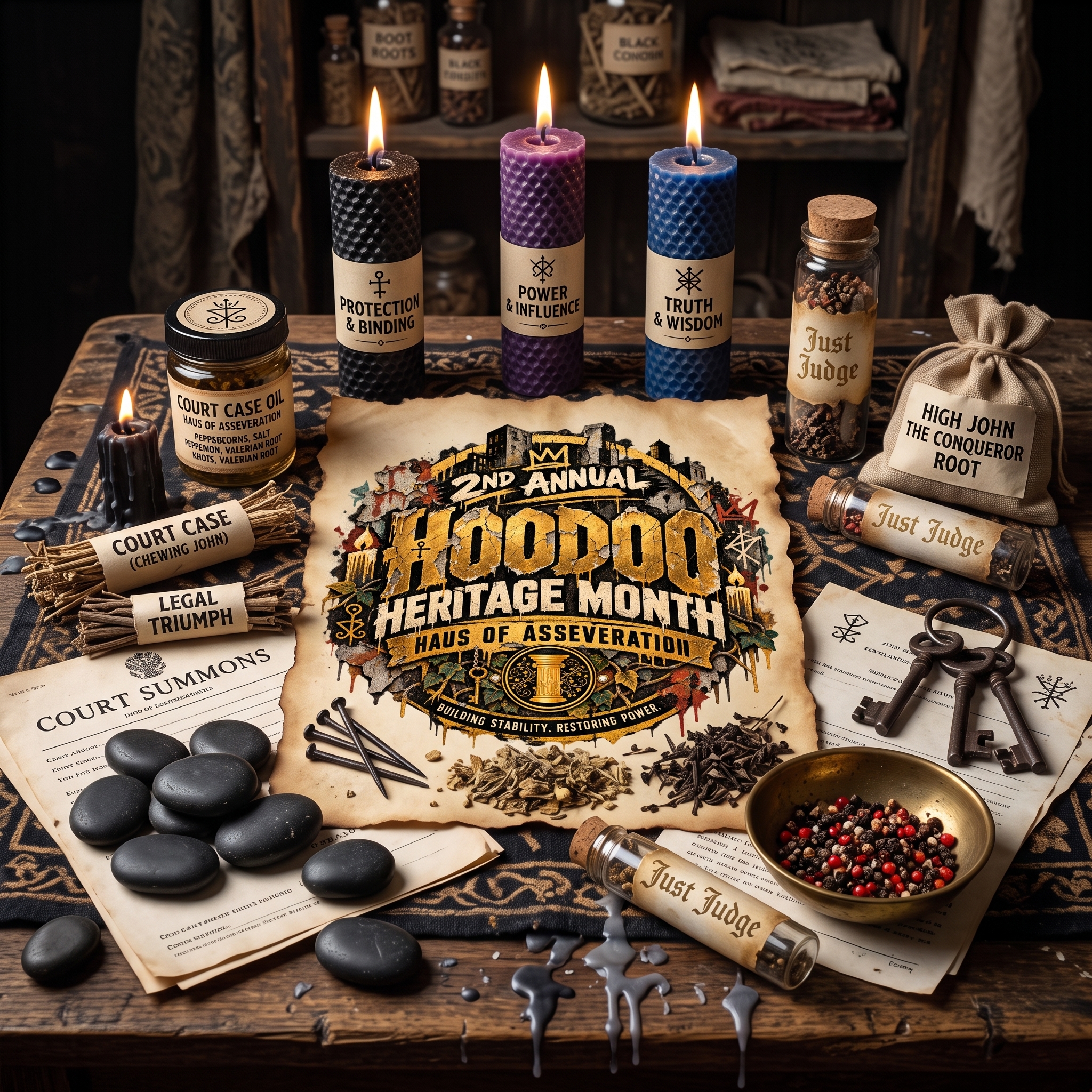
- Court-case oils and powders: Commercial Hoodoo culture eventually produced formulas sold under names such as Court Case, Just Judge, Legal Triumph and Jury Winner. These products reflected older traditions of favor and influence, even though the commercial labels themselves were modern.
- Petition papers: A person’s name, case number, hearing date or direct written request could be incorporated into a working to spiritually focus attention on the legal matter.
Historical-Inspired Practice
Preparing Yourself Before Court
A modern practitioner who wants to work within the historical logic of court-case Hoodoo can keep the practice centered on personal preparation, courage, clarity and fair treatment rather than assuming spiritual work can control a judge or guarantee a verdict.
One simple approach is to carry a small piece of High John or Galangal root, pray for steadiness and justice, and read a Psalm or personal prayer before leaving for court.
A written petition can include the case number, hearing date and a direct request for truth, fairness and clear speech.
May truth be heard clearly.
May false testimony fail.
May I speak with wisdom.
May the decision be fair.
The emphasis is spiritual preparation: staying calm, speaking clearly, remaining protected and asking that the truth of the matter receive a fair hearing.
Practical Preparation
Spiritual Work Should Stand Beside Real Legal Preparation
Hoodoo court work historically existed alongside practical survival. A modern court appearance should be approached the same way.
- Know the correct court date, courtroom and arrival time.
- Keep copies of relevant documents and evidence organized.
- Write down important names, dates and facts before the hearing.
- Follow instructions from a qualified attorney or legal-aid organization.
- Meet filing deadlines and comply with court orders.
- Prepare emotionally so that fear or anger does not prevent clear communication.
In that sense, spiritual preparation and practical preparation do not have to compete with each other.
Important Distinction
Hoodoo Can Accompany Legal Strategy — It Cannot Replace It
Historical court-case work developed because Black people often faced legal systems that were openly hostile to them.
That history should not be turned into a promise that a candle, root, oil, mojo hand or prayer can guarantee an acquittal, dismissal or favorable judgment.
Someone facing a real legal matter still needs to preserve evidence, meet deadlines, appear when required and use legitimate legal resources.
Hoodoo may be part of how someone spiritually prepares for the fight. It is not the legal defense itself.
Hoodoo Heritage Lens
Court Work Was About Power When Power Was Unequal
The deeper history of court-case conjure is not simply a list of herbs.
It is the history of Black people trying to create some form of agency inside systems where another person’s decision could determine whether they were punished, imprisoned, separated from family or denied justice.
Roots, prayer and conjure belonged to a larger tradition of surviving circumstances in which formal power was distributed unequally.
That is why Court Case Conjure belongs in the Hall of Records.
Community Archive
What Should the Hall Record Next?
Hoodoo Heritage Month submissions are reserved for the descendant Black American community, including Foundational Black American, Soulaan and ADOS contributors.
If your family or community holds a documented piece of Hoodoo history, submit it for Hall of Records review.
Family testimony about court roots, prayer traditions, old oils, mojo hands, legal-work recipes, spiritual workers or inherited practices may help preserve parts of this history that never entered formal archives.
Sources
Review the Record
- Henry Bibb — Roots and Powders During Slavery
- Harry Middleton Hyatt Collection — Court-Case Hoodoo Oral History
- Yvonne Chireau — Black American Conjure Traditions
Research note: Historical records document roots, powders, charms and practices intended to influence authority or avoid punishment. Specific herbal correspondences such as Galangal, Calamus, Licorice and Deer’s Tongue are more clearly associated with later Hoodoo herbal traditions and should not automatically be projected onto every earlier account.
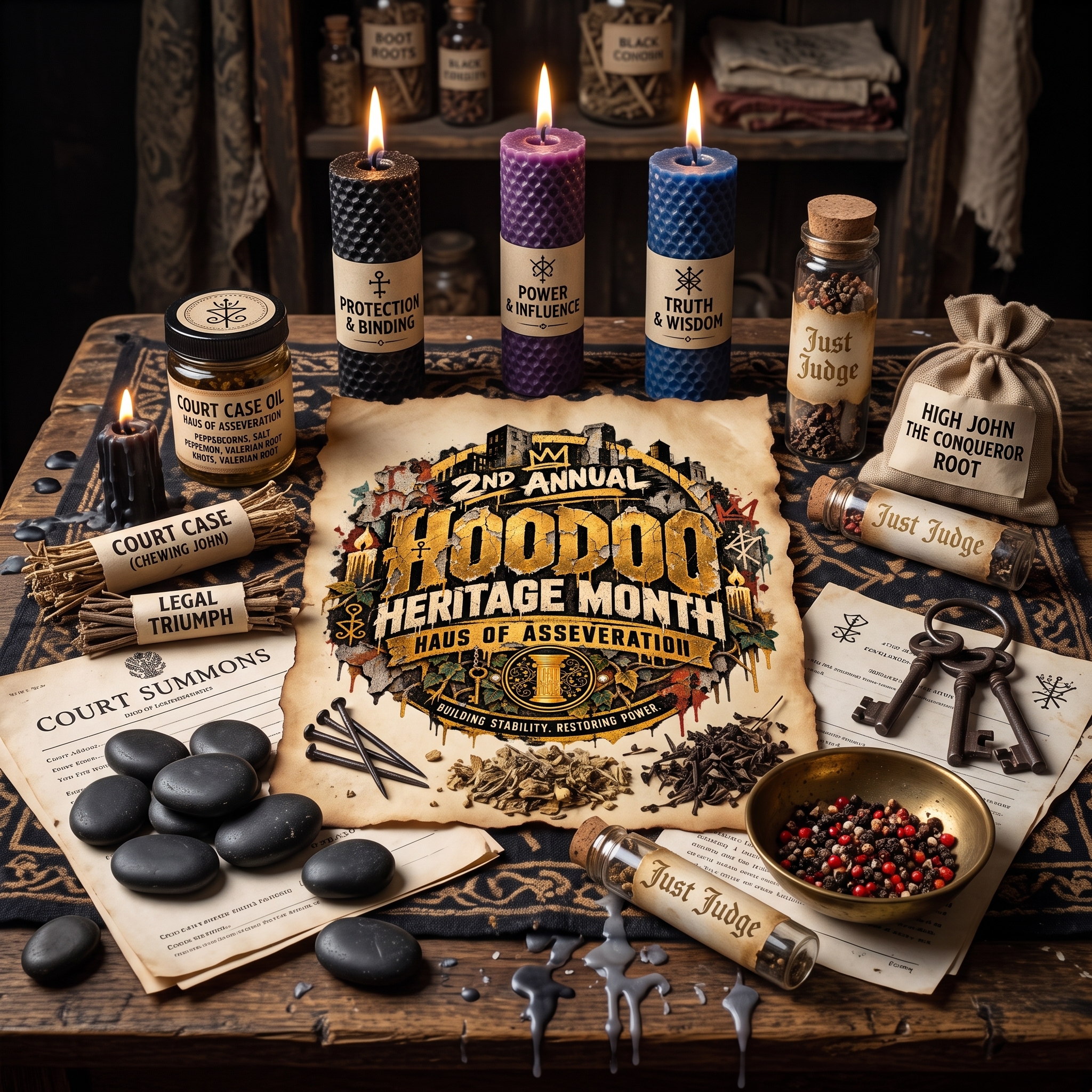
Featured image: Haus of Asseveration — Hoodoo Heritage Month 2026 campaign artwork.
Court-case work developed within Hoodoo as Black Americans faced legal systems that could affect their freedom, safety, finances and families. Historical narratives and oral-history collections document roots, prayers, sweetening practices and other spiritual responses intended to seek protection, leniency or favorable outcomes.
The record highlights Henry Bibb’s account of using a bitter root to avoid punishment and later documentation of related practices. It distinguishes spiritual tradition from legal representation, emphasizing that Hoodoo cannot replace attorneys, evidence, court filings or professional legal advice.