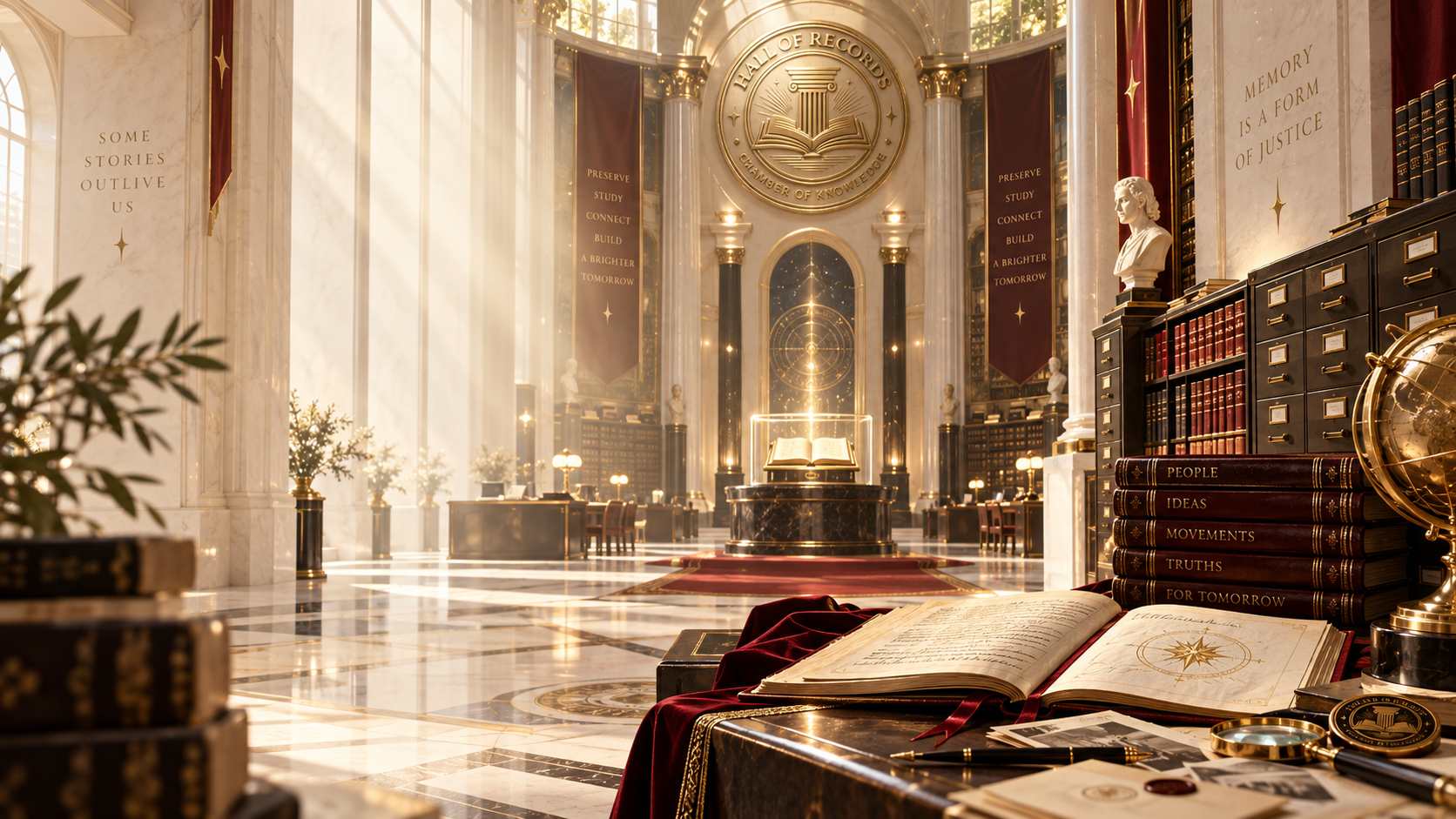
The Hall of Records is the archive inside the Chamber of Knowledge.
It preserves cases, people, places, achievements, traditions,
histories, sound, art and ideas that deserve to remain accessible.
Some stories disappear because nobody kept the paper.
Some names get reduced to a headline. Some achievements become
trivia after the people who remember them are gone.
Around here, we keep the record.
You do not have to know exactly what you’re looking for.
Browse a collection, open a record and follow the thread.
EXPLORE THE ARCHIVE
What Do You Want To Remember Today?
The Hall is organized into collections so you can move
through the archive without digging through one endless feed.
The Hall of Records is not meant to be a closed archive.
Black memory is too large for one person, one staff or one
institution to collect alone.
If you know of a person, place, achievement, case,
tradition, event, story or piece of cultural memory
that deserves a permanent place in the Hall,
you can submit it for review.
You do not have to write the finished record.
Give us the trail. The Hall can begin from there.
Memory is not passive.
Somebody has to collect it, name it, organize it
and make sure another person can find it later.
HOW THE HALL WORKS
Preserve. Contextualize. Remember.
The Hall isn’t built for endless scrolling.
It is built so records have somewhere to live
and somebody can still understand them later.
01
Preserve
Keep names, cases, people, places, cultural records,
sources and documentation together.
02
Give Context
Separate documented information, official statements,
reporting, disputed points and unresolved questions.
03
Keep It Findable
Organize memory so it doesn’t disappear the moment
public attention moves somewhere else.
KEEP MOVING THROUGH KNOWLEDGE
The Archive Is One Room In The Chamber.
Read a record. Take a class. Open the library.
Bring what you find into conversation.
Knowledge becomes more useful when the pieces can speak to one another.



 Chamber of Knowledge ←