 HausofAsseveration
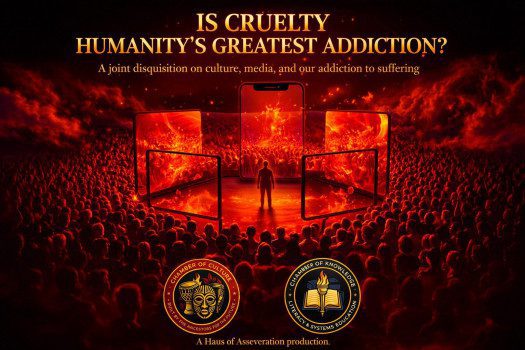
Is Cruelty Humanity’s Greatest Addiction?
From the beginning of civilization, humanity has danced with destruction — fascinated not only by survival but by the spectacle of suffering. The question we pose today is simple, yet profoundly unsettling: Is the number one addiction of humankind cruelty itself?
Origins of the Spectacle
Since the dawn of time, bloodshed has been our theater. In ancient Rome, the roar of the crowd echoed across the Colosseum as gladiators fought to the death — an entire empire enthralled by agony as entertainment. Across continents and cultures, war became the ultimate stage for valor and violence alike. Even earlier, early humans hunted not just to eat, but to dominate, to prove superiority — the kill itself a symbol of control and pleasure.
Hunting evolved beyond necessity into sport. The thrill of ending life morphed into a pastime. Trophy rooms replaced kitchens; photos replaced feasts. Even when human killing became taboo, our appetite for simulated death did not diminish — it only refined itself, adorned now in art, technology, and story.
The Evolution of Cruelty: From Coliseums to Consoles
Today, we find our modern coliseums in different arenas. We cheer for combat sports like boxing and wrestling where pain is choreographed for our delight. We immerse ourselves in video games where virtual violence becomes cathartic release — or casual recreation. Call of Duty, Grand Theft Auto, Mortal Kombat — all testament to our continued fascination with cruelty as play.
And then there is Hollywood — where horror reigns supreme.
The Horror Satire
The horror genre, perhaps more than any other, holds a mirror up to our addiction. Films like The Purge reveal how easily moral order collapses when cruelty becomes legal and commodified. IT, whether in novel, television, or film, isn’t just about a monster — it’s a satire of fear itself, mocking how humans unite only in terror.
In Escape Room, the fiction is stripped bare: horror becomes marketable, suffering becomes monetized, and death is transformed into a product for the elite. Hostel and Fear Dot Com take this further — portraying horror not as fantasy, but as reflection. These films no longer entertain; they expose. They ask, “How much would you pay to watch someone else’s pain?”
We might scoff or turn away, yet every movie ticket, every late-night binge of true crime, every replay of a boxing knockout — fuels the machine. The market only provides what we demand.
The Real Market of Suffering
Our addiction doesn’t exist in isolation. It feeds systems of oppression and spectacle that exploit the marginalized. In slavery, cruelty wasn’t just economic — it was entertainment. Public lynchings during the Jim Crow era drew crowds. In the 1990s, the “War on Crime” made Black and Brown communities the centerpieces of televised fear and punishment.
Even today, streaming docuseries about real murders top the charts. Violent lyrics, crime dramas, and gritty “street realism” are consumed as entertainment, often detached from the real suffering of the people being portrayed. Pain becomes palatable when it’s packaged well.
The Pusher and the Product
If cruelty is the addiction, then mass media is the pusher. News outlets flash images of war, police brutality, and scandal, knowing outrage drives engagement. Social networks reward agitation. Pain keeps us scrolling. Meanwhile, our desensitized youth grow up learning that empathy is inefficient, and that the line between entertainment and reality is easily blurred.
We are manufacturing apathy at scale. The heroes of tomorrow might not rescue the weak — they might broadcast the suffering live.
What Comes After Empathy Dies?
When empathy fades, society reshapes itself in terrifying ways. If we continue down this path, the future might resemble The Purge — a world where violence is catharsis, morality is obsolete, and cruelty becomes ritual. Or like Mad Max — civilization stripped to its primal instinct for domination.
The addiction to cruelty isn’t just about killing or violence; it’s about power. It is the ecstasy of watching, judging, and feeling superior to another’s pain.
The Last Question
So, is cruelty our number one addiction? Have we built an entire civilization on the foundation of watching others suffer — from the Colosseum to the comment section?
And if so, the question the Haus of Asseveration leaves you with is this:
When cruelty stops entertaining you… what will be left of your humanity?